
INTRODUCTION
When an injury keeps someone from working, the financial impact can extend far beyond a missed paycheque. In personal injury and tort claims, months of lost earnings, reduced working hours, or changes to future career prospects can all affect the compensation being sought. But how do you put a number on those losses, particularly when the parties may see the figures differently?
For lawyers preparing for mediation, having a clear, evidence-based picture of lost income can make those conversations more productive. A well-supported assessment helps bring the numbers into focus, giving both sides a firmer basis for discussing settlement.
The Numbers Behind an Income Loss Claim
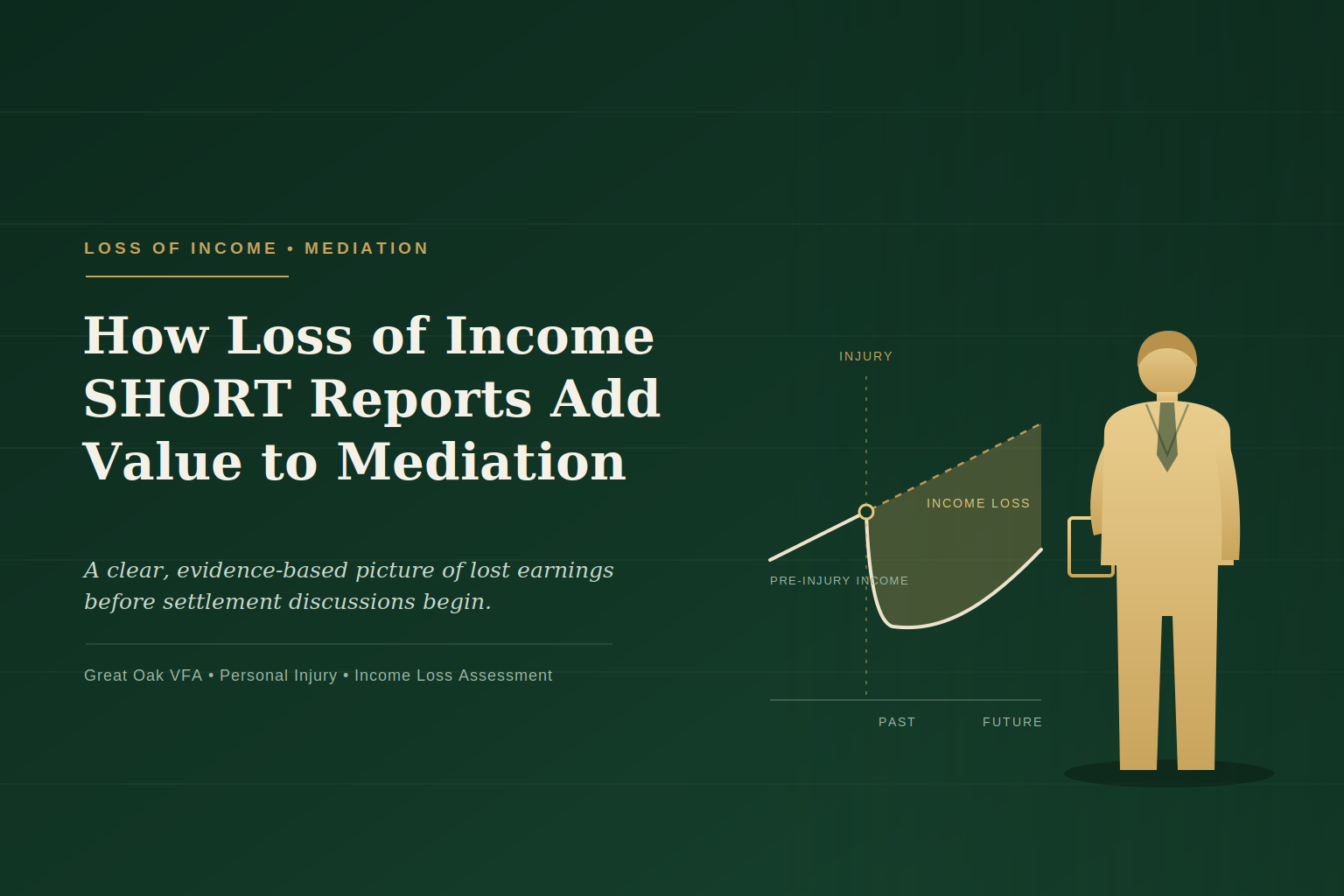
Calculating income loss involves more than just comparing what someone earned before an injury with what they earn afterwards. A claimant may have missed several months of work, returned on reduced hours, or found that they can no longer perform the same duties. Their future earnings may also be affected if the injury limits their career opportunities or ability to work.
Depending on the circumstances, an income loss assessment may consider:
- Past income loss: Earnings lost during time away from work or periods of reduced hours or working capacity.
- Future income loss: How the injury may affect the claimant’s ability to earn in the years ahead.
- Employment and earnings history: Salary records, tax returns, self-employment income, commissions, and other evidence of past earnings.
- Career and earnings prospects: Potential career progression, expected earnings growth, inflation, and the period over which losses may continue.
How SHORT Reports Help Before Mediation
Mediation gives the parties an opportunity to explore settlement with the help of a neutral mediator, without necessarily proceeding to trial. But productive discussions depend on more than putting a figure on the table. Lawyers need to understand how that figure was reached, what evidence supports it, and where questions remain.
This is where a Loss of Income SHORT Report can be useful. It provides a concise assessment of past and future income losses based on the financial records available. For less complex claims or early-stage evaluations, it allows counsel to examine the income-loss claim before committing to a more comprehensive report.
This can be useful in several ways.
- Evaluate the claim: Understand how past and future income losses have been calculated.
- Identify missing information: Determine whether additional employment, tax, or financial records are needed.
- Test assumptions: Examine whether projections are consistent with the claimant’s earnings history and circumstances.
- Prepare for negotiations: Better understand the financial issues and evaluate potential settlement positions.
- Recognise when further analysis is needed: Identify questions that may require a more comprehensive report or additional evidence.
By addressing these issues before mediation, lawyers can better anticipate challenges to the claimed losses, identify which figures or assumptions may need further explanation, and focus negotiations on the issues that remain unresolved.
It’s important to remember that a SHORT Report will not resolve every disagreement or guarantee a settlement. Liability, medical evidence, and other aspects of a claim may remain contested. Its value lies in helping lawyers examine the financial side of the case using a structured assessment rather than relying on unsupported estimates alone.
Choosing the Right Report for the Claim
Now, not every claim needs the same level of financial reporting. The appropriate approach depends on the complexity of the claim, the records available, and the extent of the income loss being considered.
Loss of Income SHORT Reports are a streamlined, cost-effective option for less complex matters and early-stage evaluations. Based on actual financial records, they provide a concise picture of past and future income losses.
A SHORT Report may be suitable when:
- The claim is relatively straightforward.
- Counsel needs an initial assessment before entering settlement discussions.
- The available financial records support a focused evaluation.
- The parties need a clearer picture of the income-loss claim before deciding on the next steps.
This can help lawyers assess the claim and determine whether a more detailed analysis is needed.
Full Loss of Income Reports, on the other hand, are designed for more complex or high-value claims where a detailed financial assessment is essential. Depending on the circumstances, they can include:
- A comprehensive review of past and projected future income.
- Analysis of pre-accident earnings and career trajectory.
- Consideration of inflation assumptions, work-life expectancy, and potential future earnings.
- Detailed calculations to support mediation, arbitration, or court proceedings.
- Signed expert duty form
A full report may be appropriate when the claimant’s earnings history is complicated, future earning capacity is disputed, or the financial issues require closer examination.
The distinction is not simply about the length of a report. It is about matching the level of reporting to the needs of the case rather than assuming every claim requires the same amount of work.
At Great Oak VFA, our Loss of Income SHORT Reports help lawyers assess past and projected future income losses using the claimant’s financial records. They are designed for less complex claims and early-stage evaluations, giving counsel a clearer understanding of the income-loss component before deciding whether a more extensive report is necessary. Where a case requires further examination, we also offer full loss of income full reports, with expert commentary and signed expert duty form. Hundreds of lawyers have already relied on the SHORT as a cost-effective tool to strengthen their negotiating position and settle their claim
To learn more about our Loss of Income SHORT Reports or discuss a claim, contact us at info@greatoakvfa.ca