
INTRODUCTION
When a business is involved in a family law matter, determining its value is often a key part of the overall financial analysis. Unlike publicly traded investments, a privately held business does not have a readily available market value. Instead, its value must be determined through an independent valuation that considers the unique financial and operational characteristics of the business.
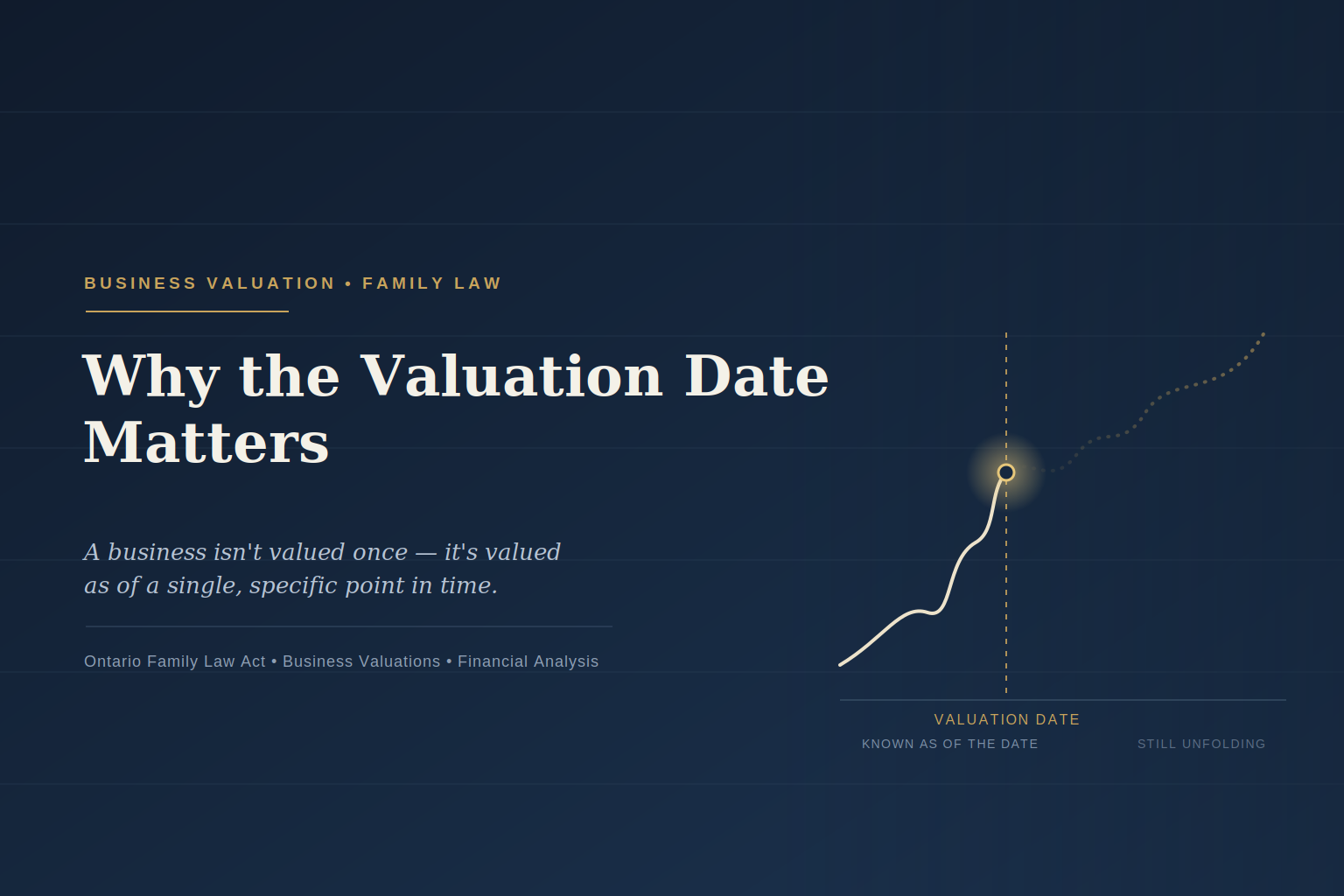
An equally important consideration is the valuation date, the specific point in time at which the business is assessed. In Ontario family law matters, the applicable valuation date is established under the Family Law Act, and the valuation reflects the business as it existed as of that date. Because businesses continue to evolve, the valuation date can significantly influence the value determined and the financial conclusions that follow.
The Date That Shapes the Valuation
A business valuation is not simply about determining what a company is worth; it’s about determining what it was worth at a specific point in time. That point in time is known as the valuation date.
The valuation provides a financial snapshot of the business based on the information that was known or reasonably knowable as of that date. This may include factors such as:
- Financial performance
- Assets and liabilities
- Cash flow
- Industry conditions
- Economic factors
- Market expectations
Because businesses change over time, a valuation prepared for one date may differ from a valuation prepared months later, even if ownership remains unchanged.
Why Timing Can Change the Value
Business value is rarely static. Day-to-day operations, financial performance, and broader market conditions can all influence what a business is worth over time.
For example, the value of a business may be affected by:
- Revenue growth or decline
- Changes in profitability
- New contracts or the loss of key customers
- Acquisition or disposal of assets
- Changes in debt levels
- Industry trends and economic conditions
A business experiencing strong growth may have a very different value than it did only months earlier. Likewise, changing market conditions or operational challenges may reduce value over time.
Since a business valuation reflects the facts and circumstances that existed on the valuation date, these changes can lead to different valuation conclusions. This is why selecting the appropriate valuation date is a fundamental part of the valuation process.
Why the Valuation Date Matters in Family Law Matters
Business and asset valuations often form part of the financial analysis required in family law matters. Preparing an independent valuation as of the appropriate valuation date helps ensure that the business is assessed using the relevant financial information and circumstances that existed at that point in time.
Depending on the circumstances, the valuation may also support Net Family Property (NFP) calculations, helping establish the value of a business or professional practice for equalization purposes. Using the appropriate valuation date provides a consistent foundation for the analysis and helps ensure the business is evaluated as it existed during the relevant period.
The quality of the analysis depends not only on the financial information available, but also on ensuring that the appropriate valuation date is applied throughout the engagement.
Where Business Valuation Experts Fit Into the Process
Determining the fair market value of a privately held business involves far more than reviewing financial statements. It requires careful analysis of financial performance, business operations, industry conditions, and economic factors to develop an objective and well-supported valuation.
Depending on the needs of the engagement, valuation and forensic accounting services may include:
- Business and asset valuations
- Net Family Property (NFP) calculations
- Goodwill analysis
- Income analysis
- Property and financial disclosure support
- Expert witness services
- Comprehensive, estimate, calculation, or advisory reports
Together, these services provide legal professionals with objective financial analysis to support negotiations, mediation, arbitration, or litigation.
Business valuations can be one of the most significant financial components of a family law matter. Understanding the role of the valuation date helps ensure that financial decisions are supported by a well-founded and reliable valuation.
At Great Oak VFA, we provide independent business and asset valuations, NFP calculations, income analysis, financial reporting, and expert witness services. Our team works with legal professionals and their clients to deliver objective financial analysis tailored to the unique circumstances of each engagement.
To learn more about how Great Oak VFA can support your family law matters, connect with our team at info@greatoakvfa.ca