
INTRODUCTION
When a fire, flood, cyber incident, or other unexpected event disrupts a business’s normal operations, the financial impact can extend well beyond the cost of repairing physical damage. Revenue may decline while expenses such as rent, salaries, and other operating costs continue. The business may also incur additional costs to continue serving customers or restore its operations.
Business interruption (BI) insurance is intended to address certain financial losses resulting from an interruption, subject to the terms and conditions of the applicable insurance policy. Because BI policies differ in their coverage, definitions, limits, waiting periods, and indemnity periods, calculating a business interruption loss is rarely as simple as comparing revenue before and after an event.
For larger, complex, or disputed claims, a Chartered Business Valuator (CBV), forensic accountant, or other financial loss specialist may be engaged to quantify the loss and provide support for the calculation.
What Can Trigger a Business Interruption Claim?
Business interruption claims can arise when an insured event prevents or restricts a business from operating normally. Common examples include:
- Fire, smoke, or water damage;
- Flooding and other property damage;
- Equipment breakdown;
- Utility interruptions;
- Cyber incidents or system outages; and
- Disruptions affecting suppliers or other third parties, where the applicable policy provides coverage.
It is important to note that not every business disruption is automatically covered by business interruption insurance. Coverage depends on the wording of the applicable policy, including the insured peril, coverage extensions, exclusions, and other conditions.
For example, a retail business may be forced to close for several weeks following significant water damage. During the closure, it may lose sales while continuing to incur expenses such as rent, insurance, and certain employee costs. It may also incur additional expenses to operate from a temporary location or expedite repairs.
A business interruption loss analysis brings these factors together to determine the financial loss attributable to the interruption.
The Basic Business Interruption Loss Calculation
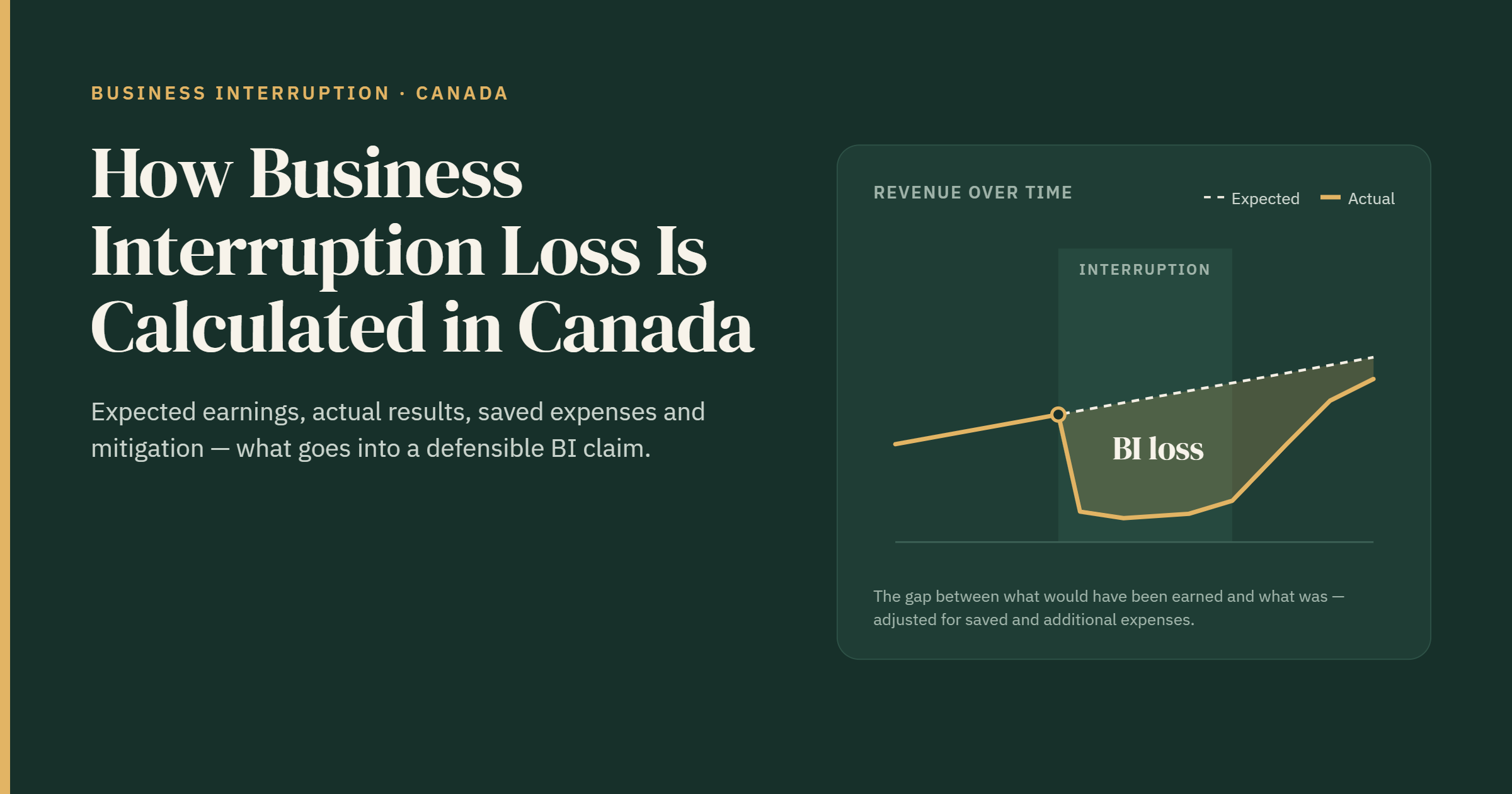
At a basic level, a business interruption calculation asks the question:
“What would the business have earned if the loss had not occurred, compared with what it actually earned?”
Answering that question is where the analysis becomes more involved.
The first step is to establish a reasonable estimate of the business’s expected performance during the interruption period. This may involve looking at historical results, recent growth or decline, seasonality, budgets, customer trends, industry conditions and other information that helps establish what the business was likely to achieve. That expected result is then compared with what actually happened.
The difference is not necessarily the final business interruption loss. The calculation also needs to consider expenses that were saved because the business was operating at a reduced level, as well as additional expenses incurred to keep the business operating or reduce the impact of the interruption.
For example, a business might have expected to generate $1 million in revenue during the interruption period but only generated $400,000. That does not automatically mean the business interruption loss is $600,000. The business would have incurred some costs to generate the additional $600,000 of sales, and some of those costs may have been avoided when sales declined. At the same time, the business may have incurred additional expenses to continue operating.
This is why a BI calculation is more than simply measuring the decline in revenue.
Establishing What the Business Would Have Earned
One of the most challenging parts of a calculating a business interruption loss claim is determining what would have happened if the loss had never occurred. There is no financial statement showing this result. It has to be reconstructed using the information available before and after the loss.
Historical results are usually an important starting point, but they are not necessarily the answer. A business may have been growing or declining before the loss. It may have been opening a new location, losing customers, increasing prices, or changing how it operated.
Seasonality can also make a significant difference. A retailer that generates much of its revenue during the holiday season cannot simply use an average monthly revenue figure to estimate what it would have sold in December. Similarly, a tourism business may have very different expected results in July than in January.
Other factors may need to be considered as well, including:
- Recent sales and customer trends;
- Budgets and forecasts prepared before the loss;
- Pricing changes;
- Changes in capacity;
- New contracts or lost customers;
- Industry growth or decline;
- Economic conditions; and
- Other circumstances affecting the business before the interruption.
The objective is to develop a reasonable estimate of what the business would have achieved, rather than using the assumption that its historical performance would have continued unchanged.
Actual Results Matter Too
The BI calculation also needs to account for what the business actually did during the interruption.
A business may shut down completely, but that is not always the case. It may continue operating from another location, work at reduced capacity, use alternative suppliers, move employees to another facility, or find other ways to continue serving customers. Those efforts can reduce the financial loss.
For example, if a manufacturer normally produces 10,000 units per month but a fire reduces production capacity by half, the business may still generate substantial revenue. The BI calculation needs to distinguish between the revenue actually earned and the revenue that would reasonably have been earned had the fire not occurred.
The same principle applies when a business recovers some of its lost sales after reopening. The timing and extent of that recovery can affect the overall loss.
Gross Profit, Gross Earnings and Business Income
There is no single formula that applies to every BI claim.
The calculation depends in part on the wording of the insurance policy. Different policies may use terms such as gross earnings, gross profit, business income, or profits, and those terms may have specific definitions for insurance purposes.
That distinction matters because the definition of “gross profit” in an insurance policy may not be the same as the gross profit reported in a company’s financial statements.
In practice, the financial analysis may be approached from the top down, the bottom up, or a combination of the two.
A top-down approach generally starts with the financial results that the business would reasonably have achieved absent the interruption. Historical revenue, growth rates, seasonality, budgets, and other financial information may be used to establish expected revenue, which is then applied to the appropriate policy-defined margin to estimate the resulting loss.
A bottom-up approach instead builds up the expected results from the underlying operational drivers of the business. For example, a hotel might be analyzed using expected occupancy and room rates; a manufacturer might be analyzed using production capacity, units sold, and selling prices; and a professional services business might be analyzed using billable hours, utilization, and billing rates. The associated expenses are then considered to determine the resulting financial loss.
In many claims, the strongest analysis uses both approaches as a cross-check. A financial forecast developed from the business’s underlying operating drivers can be compared with the historical financial results and broader trends to determine whether the resulting estimate is reasonable.
The appropriate approach depends on the policy, the nature of the business, and the information available.
Saved Expenses
One of the easiest mistakes to make in a BI calculation is to treat all lost revenue as lost profit. A business normally incurs costs in generating revenue. If sales fall because of an interruption, some of those costs may also fall. These are generally referred to as “saved expenses”, and they need to be considered when calculating the financial loss.
For example, a retailer may purchase less inventory. A restaurant may buy less food. A manufacturer may use less raw material. A business may also incur lower credit-card fees, shipping costs, commissions or other expenses that vary with sales.
Other expenses may continue even when the business is closed or operating at reduced capacity. Rent, insurance and certain salaries are common examples, although the treatment of each expense depends on the circumstances and the applicable policy.
Understanding which expenses actually change when revenue changes is therefore an important part of the analysis.
Additional Expenses and Mitigation
Businesses will often take steps to limit the financial impact of an interruption.
A company might rent temporary premises, pay overtime, purchase replacement equipment, use a more expensive supplier, outsource part of its operations, or pay to have materials shipped on an expedited basis.
These costs can sometimes be significant. They may also allow the business to continue generating revenue that otherwise would have been lost.
This is where mitigation becomes relevant. A business may take reasonable steps to reduce the financial impact of an interruption, and the costs of those efforts may also be relevant to the claim, depending on the policy.
The analysis therefore needs to consider both sides of the equation: what was lost and what was done to reduce the loss.
How Long Does a Business Interruption Loss Last?
The amount of a business interruption loss is also affected by the period over which the loss is measured. This is not necessarily the same thing as the time it takes to repair the physical damage.
The applicable policy may contain a waiting period and a maximum indemnity period and may define the period over which the business interruption loss is covered.
For example, a business might physically reopen after three months but continue operating below its expected level while it rebuilds its customer base. Whether those continuing losses are covered depends on the policy and the circumstances.
Similarly, a business might take longer than necessary to resume operations for reasons unrelated to the insured damage. Those issues can affect the calculation as well.
Determining the appropriate loss period therefore requires both an understanding of the business and careful consideration of the policy wording.
Separating the Loss From Other Business Problems
This is often where a BI analysis becomes much more than an accounting exercise. A business’s revenue might have declined after a fire, but that does not necessarily mean the entire decline was caused by the fire.
Perhaps the business was already losing a major customer. Perhaps the industry was slowing down. Perhaps a new competitor has entered the market. Perhaps the business had been struggling with staffing issues before the loss. The opposite can also be true. If a business grew rapidly before the loss, there may be good evidence that some of that growth would have continued.
The goal is to separate the financial impact of the insured event from the financial impact of everything else that was happening to the business. This is one of the areas where professional judgment becomes important. The analysis needs to be grounded in evidence rather than simply selecting the assumption that produces the highest or lowest claim.
What Information Is Needed?
The information required will depend on the business and the nature of the claim, but a BI analysis may involve reviewing:
- Financial statements and general ledgers;
- Tax returns;
- Budgets and forecasts;
- Sales and point-of-sale records;
- Customer and order information;
- Payroll records;
- Bank statements;
- Inventory records;
- Production information;
- Industry data; and
- Other operational information.
The more closely the financial and operational analysis can be tied to the way the business actually generates its income/gross profits/gross margins, the more reliable the calculation is likely to be.
The Role of a CBV or Forensic Accountant
A business interruption claim is fundamentally a financial loss quantification exercise. Depending on the circumstances, this work can be performed by a Chartered Business Valuator (CBV), forensic accountant, or another professional with appropriate experience in financial loss analysis.
A CBV’s experience can be particularly relevant where the claim requires analysis of historical financial performance, forecasting, business trends, margins, customer activity, and other factors used to establish what the business would reasonably have earned.
Forensic accountants can bring additional expertise in accounting records, financial investigations and tracing or analysing complex transactions. In some claims, those skills may be particularly important.
The right professional depends on the nature and complexity of the claim. A professional assisting with a BI claim may be asked to:
- Establish the expected financial performance of the business;
- Analyse actual results during the interruption;
- Determine the effect of saved expenses;
- Assess additional expenses and mitigation efforts;
- Consider trends and other factors affecting the business;
- Quantify the resulting financial loss; and
- Prepare supporting schedules and documentation for the insurer, adjuster, legal counsel or court.
For larger or disputed claims, having an independent financial professional involved can also help identify issues early and provide a clear basis for discussions between the insured and insurer.
Conclusion
Calculating a business interruption loss is ultimately an exercise in reconstructing what would reasonably have happened to a business if the insured event had not occurred.
That requires more than taking the difference between pre-loss and post-loss revenue. The analysis needs to consider the business’s underlying trends, seasonality, expected growth, actual performance, saved expenses, additional costs, mitigation efforts, and the factors that may have affected the business regardless of the loss.
The calculation must also be considered in the context of the applicable insurance policy. Coverage provisions, definitions, waiting periods, indemnity periods, and limits can all affect the amount ultimately recoverable.
A CBV or forensic accountant with appropriate experience in financial loss quantification can help develop a well-supported calculation and provide the financial analysis needed to evaluate a complex or disputed BI claim.
The objective is not simply to arrive at a number. It is to arrive at a number that can be explained, supported by evidence, and defended when the underlying assumptions are examined.
At Great Oak VFA, our team of CBVs and forensic accountants provides independent business interruption loss quantification for insurers, legal counsel, and businesses across Canada. We apply detailed financial analysis to quantify the impact of an interruption and prepare reports tailored to the circumstances of each engagement.
To learn more about business interruption loss quantification or to discuss a claim, contact us at info@greatoakvfa.ca.